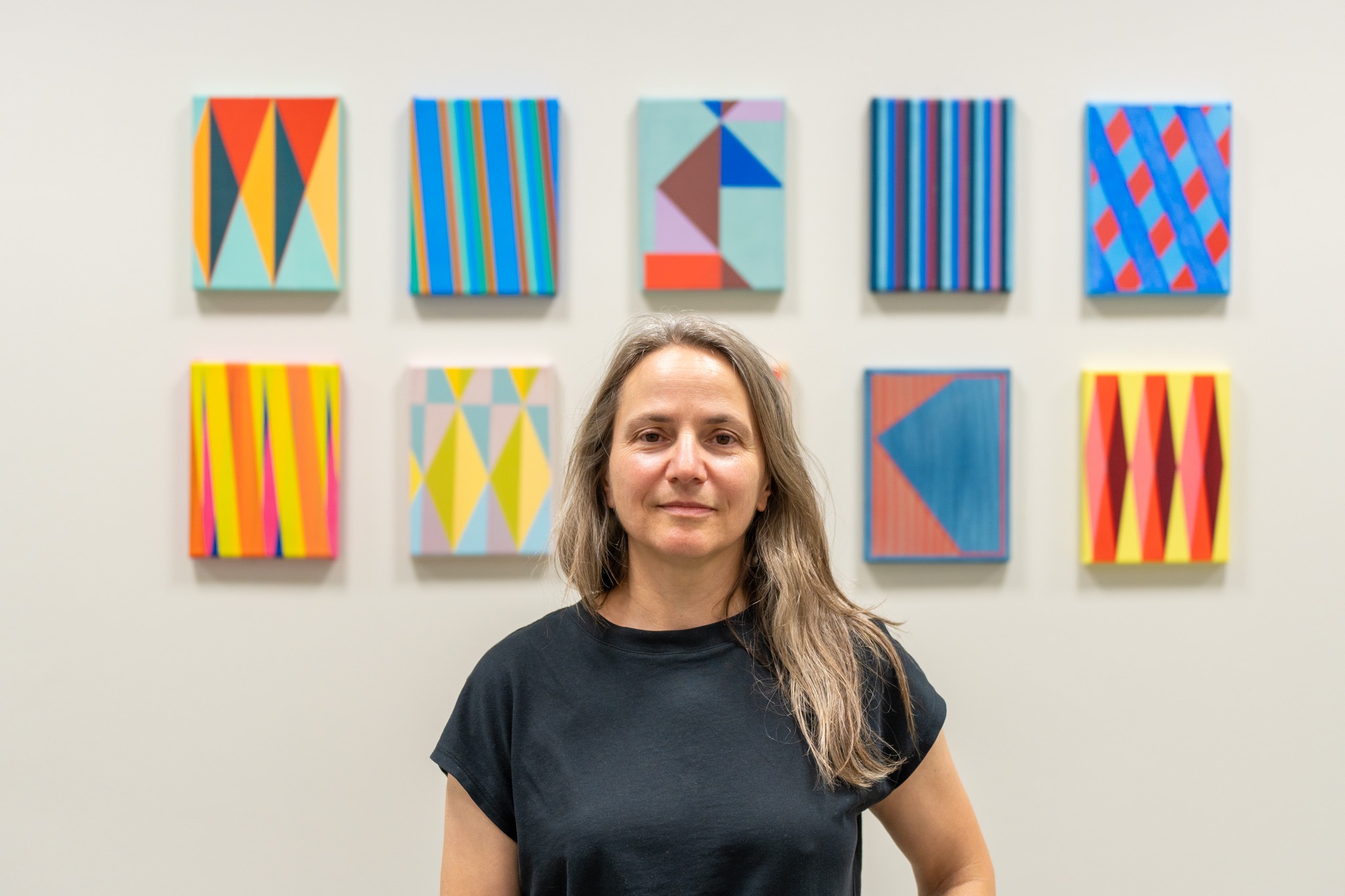
Foto: George Kogias © Goethe-Institut Thessaloniki, 2025
2026
Working Scholarship for Fine Arts,
Stiftung Kunstfonds
2025
Working Scholarship for Fine Arts, Senate of Berlin
2025
Artist-in-Residence, Goethe-Institut, Thessaloniki / Greece, in cooperation with MOMus-Museum of Modern Art / Costakis Collection, Thessaloniki
2023
Neucoelln Art Award 2023, Berlin-Neukölln District Office & Stadt- und Land Wohnbauten GmbH, won: Special Price
2018
5. International André-Evard-Award for concrete-constructive Art, Kunsthalle Messmer, Riegel at Kaiserstuhl / Nominination
2010
2. International André-Evard-Award for concrete-constructive Art, Kunsthalle Messmer, Riegel at Kaiserstuhl / Nominination
2004
Artist Studio Funding, Senate of Berlin
Study
Fine Arts / Painting, University of Arts Berlin-Weissensee (KHB) with Prof. Hanns Schimansky
Degree: Diploma & Master class in Fine Arts / Painting, University of Arts Berlin-Weissensee (KHB), with Prof. Hanns Schimansky
Education
Printing technology / offset printing, bfw, Berlin
Concrete worker with high school diploma, housing construction combine “Fritz Heckert”, Berlin
Born in Berlin (East), former GDR
Lives and works in Berlin, Germany
Neukölln Art Award
won: Special Prize, awarded by the Stadt & Land Wohnbauten Gesellschaft GmbH
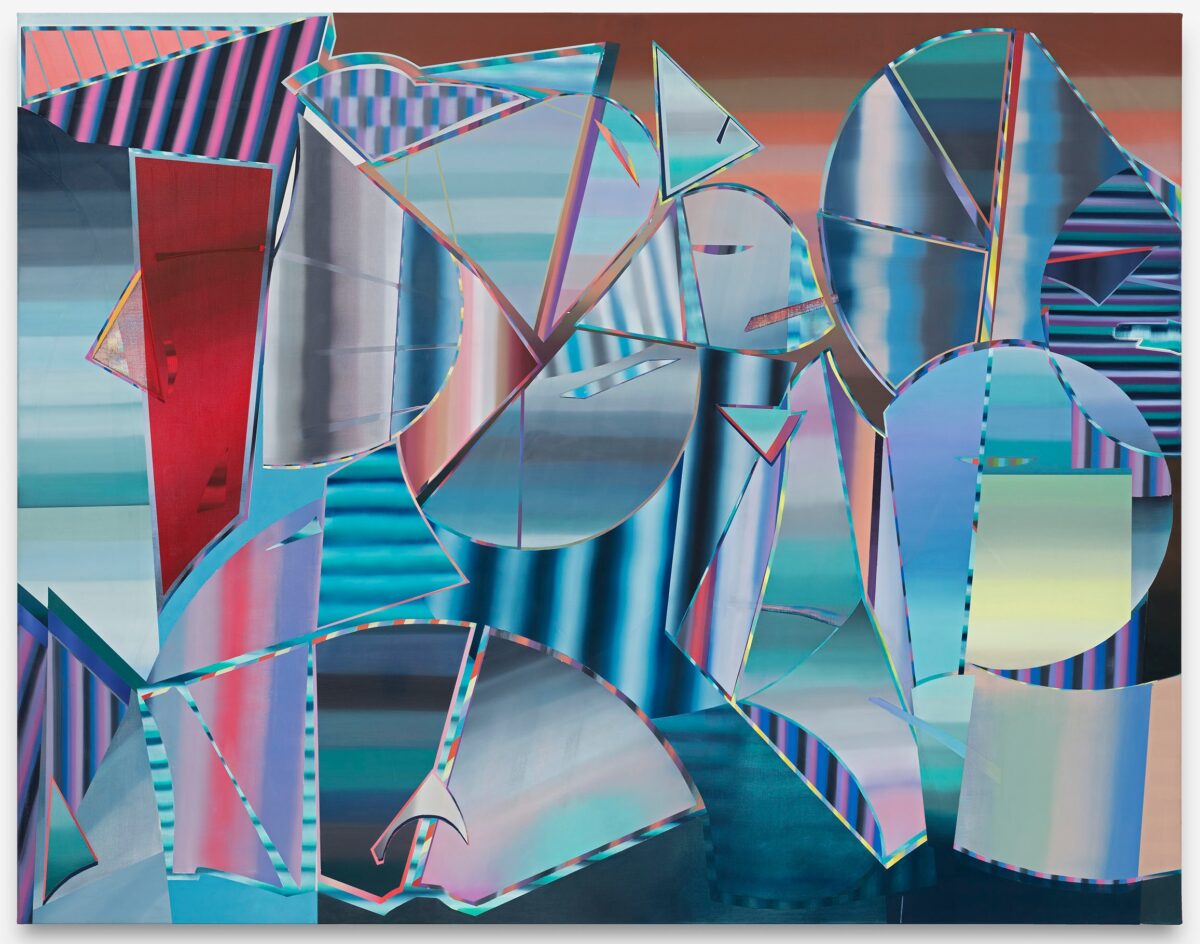
Nomination for the 5th André-Evard-Art Award of the Messmer Foundation
Nomination for the painting "Interferenz I" (2018, oil on canvas, 115x145cm)
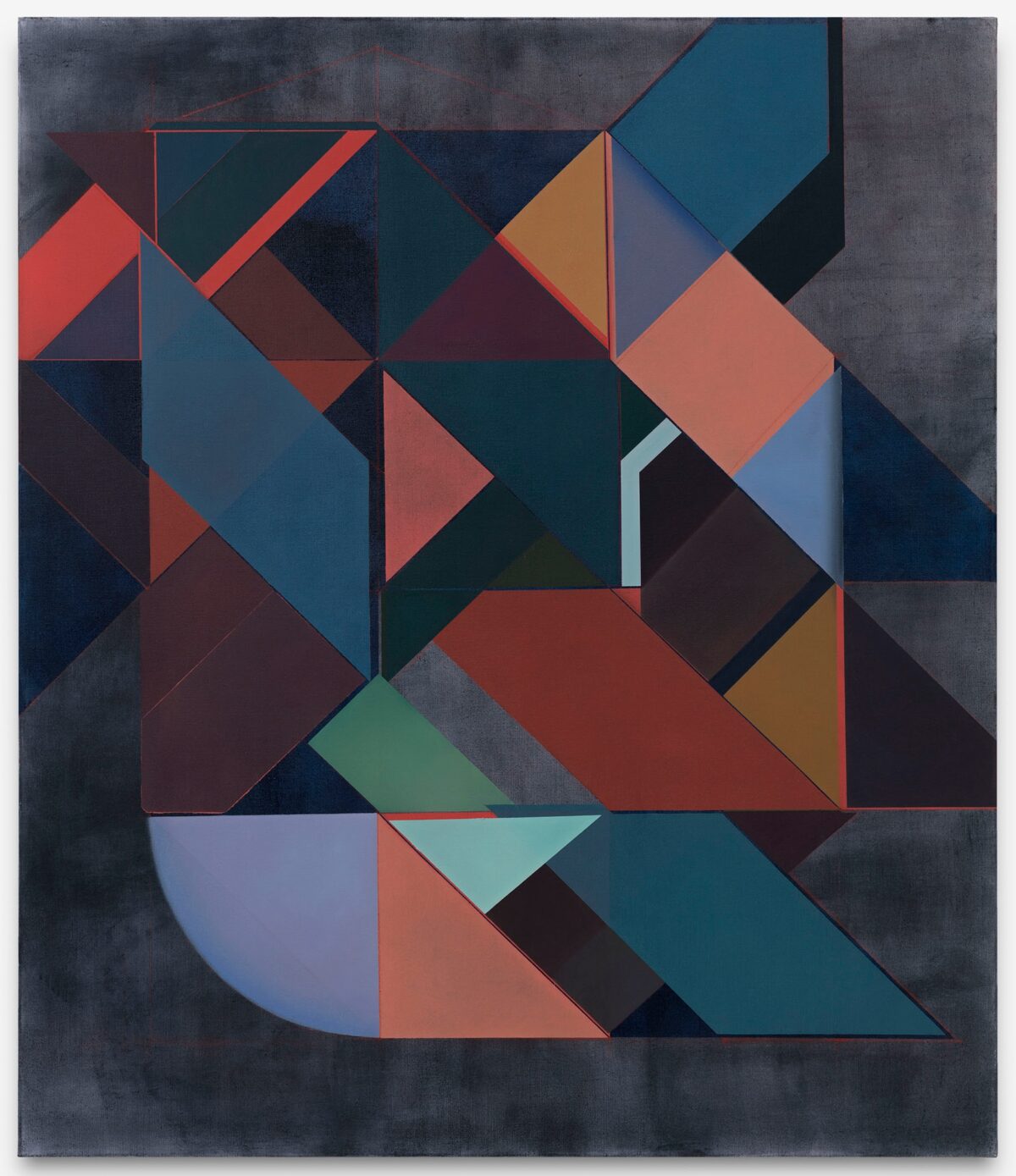
2th André-Evard-Art Award of the Messmer Foundation
Nomination for the painting "KREIS ROT" (2009, oil on canvas, 120x140cm)
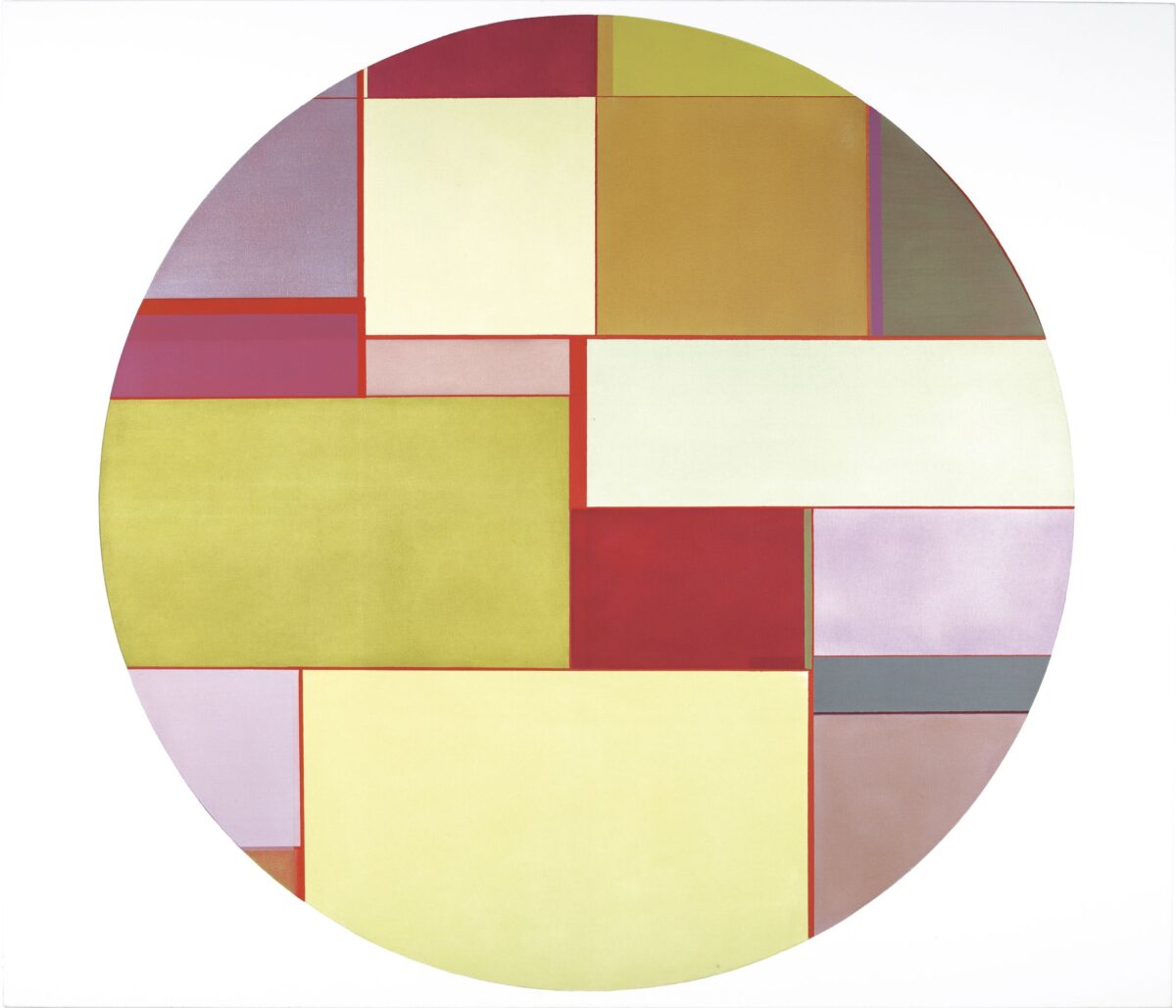
THE CONSTRUCTIVIST DIARY
In dialogue with MOMusModern-Costakis Collection
Goethe-Institut Thessaloniki, Greece
In the exhibition “The Constructivist Diary – in dialogue with MOMusModern-Costakis Collection,” Antje Taubert presents new works created through her exploration of artworks by Lyubov Sergeyevna Popova (1889–1924), whose works are housed in the MOMusModern-Costakis Collection Museum in Thessaloniki.
In collaboration with the museum and with the support of the Goethe-Institut, the artist developed these works as an artist-in-residence at the Goethe-Institut Thessaloniki in May/June 2025.
“The Constructivist Diary” is, on the one hand, a homage to an outstanding artist. At the same time, historical Constructivist design principles are translated into the here and now through adaptation and variation, thus transforming them into a new aesthetic existence.
The exhibition was part of the celebrations for the 70th anniversary of the Goethe-Institut Thessaloniki.
THE CONSTRUCTIVIST DIARY
Reviewed by Karl-Michael Schmidt, physicist, agricultural scientist, patent attorney, Moers, July 6, 2025
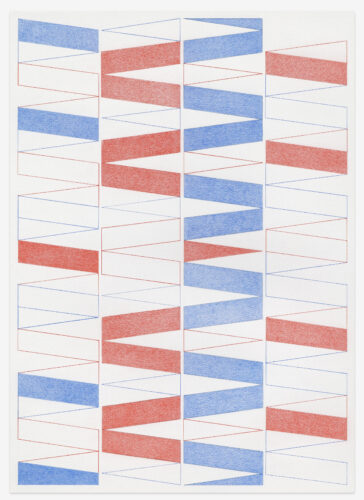
The level of abstraction in Antje Taubert’s paintings allows for associations with biophysical patterns,
although this work, like many of her works, creates apparent regularity while in reality disrupting it.
Through the use of lines, colors, and forms, a transition from the crystalline, entropy-driven arrangement of dead matter to the disruption of the entropy law of living matter is created/represented by breaking through strict apparent periodicity. What is remarkable, however, is that this representation results not from planning, but from pure creative work. To put it more pathetically, but no less aptly, this is, so to speak, an inherent sensitivity within the artist for correspondences with the great blueprint of nature – principles inherent in all living matter.
Specifically, this work allows for a comparison with so-called “folding” in the structural plan of proteins from amino acids. In molecular biology and biophysics, the quantum mechanical entanglements of such macromolecules resulting from protein folding have long been used as interpretive models to understand the electrodynamic aspects of electron conduction in chloroplasts during photosynthesis.
What is striking about this work is that the virtual vertical dividing lines do NOT result in symmetries, yet the entire work nevertheless appears quantized. This corresponds precisely to the biological reality.
With her talent, the artist Antje Taubert once again demonstrates that the image of nature created by humans, however abstract it may be, can always also be a depiction of the microcosm and macrocosm that not only surrounds us but also resides within us.
The Constructivist Diary XI, 2025, coloured pencils on paper, 58,7x42cm
COLOR, SURFACE, FORM
Basement - space for art, Berlin
Die Ausstellung farbe, fläche, form präsentiert eine Vielfalt künstlerischer Positionen, die unterschiedliche Generationen und Herangehensweisen an die Malerei vereinen. Diese Künstlerinnen und Künstler erweitern traditionelle Grenzen und erkunden neue Dimensionen des künstlerischen Ausdrucks, was in der Interaktion von Materialien, Techniken und konzeptuellen Ideen sichtbar wird.
In der gegenwärtigen Kunstwelt ist künstlerisches Schaffen oft mit sozialen oder politischen Fragen verknüpft. Kunst muss jedoch nichts sein und kann alles sein, was zu einer immensen Vielfalt führt, wenn wir dies zulassen. Obwohl die Ausstellung auf den ersten Blick um die titelgebenden Begriffe farbe, fläche, form zu kreisen scheint, geht es im Kern um Künstler*innen, die sich intensiv mit der Entstehung malerischer Bildwerke und den dahinterstehenden Prozessen auseinandersetzen.
Hier steht L‘art pour l‘art im Vordergrund – Kunst um der Kunst willen.
…
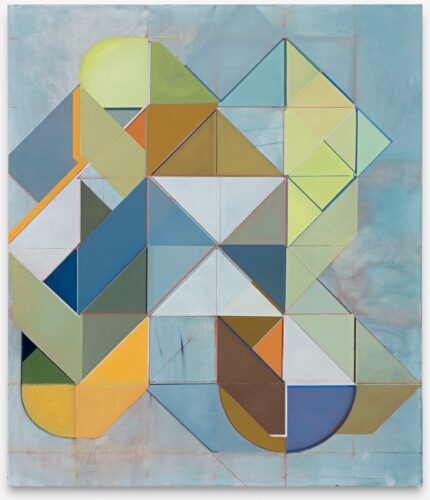
Antje Taubert spielt in ihrer Werkreihe Interferenz mit Farben und nutzt ihre Palette als Labor. Indem sie Farbflächen scheinbar zufällig und ungeordnet aufeinandertreffen lässt, löst sie die geometrische Harmonie früherer Werke auf. Die daraus entstehenden mutigen, ungeplanten Strukturen treten aus der Fläche hervor, bilden Räume und assoziieren bekannte urbane Strukturen.
…
Diese Ausstellung verdeutlicht nicht nur die Vielfalt und Tiefe abstrakter und ungegenständlicher Malerei, sondern zeigt auch, wie diese Kunstwerke im Dialog mit ihrer Umgebung und den Betrachter*innen stehen.
SPACE WORLDS
Town Hall Gallery Berlin-Reinickendorf, Berlin
(…) It’s about different concepts of space – a term that covers a very broad spectrum in both geosciences and cultural studies. “We deliberately defined the term very narrowly and related it exclusively to urban spatial structures,” explains Ricarda Vinzing. The result is an exhibition that conveys eight very different positions of contemporary artists, all of whom have dealt with urban planning and different concepts of space. “The connecting element of the works on display is architecture,” says curator Vinzing, “either as a defining element of urban space, as a basis for constructive compositions or as an expression of social and political conditions.”
(…) Composed of geometric, overlapping elements, Antje Taubert creates abstract color spaces in her paintings. The individual elements seem to almost emerge from the canvas. “The pictures therefore have a high presence in the room,” emphasizes Ricarda Vinzing.
NEUCOELLN ART AWARD 2023
Nominee exhibition, Gallery at Saalbau Neucoelln, Berlin
The Artist Antje Taubert’s drawings and paintings reveal her interest in mathematical themes, landscape formations, architecture and geometry. Sources of inspiration for her works are often literature or music.
For her painting Baroqueizing Deviation, Antje Taubert took the science fiction novel Solaris by the Polish author Stanisław Lem from 1961 as a starting point.
She was particularly fascinated by the pictorial descriptions of the intelligent ocean that almost completely covers the planet Solaris and with which mankind is trying to make contact.
The artist dissected the book analytically, collected and arranged individual word finds and quotations, especially the passages about the unusual formations and reflections of the ocean and the numerous, detailed color descriptions. Intuitively, the artist translated what she had read into form and color.
Her painting Baroqueizing Deviation is composed of basic geometric shapes – circles, triangles, rectangles and curves that intersect and interlock. A spatiality was created in which the uniform surfaces seem to dissolve and break up. The many color gradients, stripes and color gradations seem like reflections or blurs, the shapes like mechanical machine parts, flying space junk or interlocking gears.
Antje Taubert’s painting was created against the background of complex themes such as the conquest of space and the attempt to make contact with extraterrestrial life, and through its abstraction and complexity leaves room for the thoughts and associations of the viewer.
Info text of the jury for the exhibition entry Baroqueizing Deviation (2021-22, oil on canvas, 180x230cm)

NEUCOELLN ART AWARD 2023
STADT UND LAND awards special prize to artist Antje Taubert
As part of this year’s Neukölln Art Prize ceremony, STADT UND LAND-Wohnbauten-Gesellschaft mbH has awarded a special prize for the seventh time in a row. Antje Taubert’s work of art “Baroque deviation” takes up concepts from futuristic literature and creates her own extraterrestrial landscape. The artist works in Bauhaus aesthetics with clear geometric shapes, which she repeatedly breaks using stencil technology, thereby creating the effect of an artificially designed surface. The resulting landscape is reminiscent of a retrofuturistic stage on which human existence no longer plays a superficial role.
DOUBLE TRACK- COLOUR AND GEOMETRY
An Essay by Dr. Gabi Ivan, 2020
Antje Taubert is an artist interested in scientific and geometrical aspects. She observes real-world phenomena with a unique analytical eye, dissecting their blueprints and building modules, and later translating them from what she perceives and recognizes into a comprehensive and independent aesthetic order of colors and forms. This is the result of thoughts, associations, and intuitions that unfold between preceding or accompanying drawings and the subsequent canvas painting.
After two decades of concentrated work, Antje Taubert roamed numerous paths and side paths that never proved to be dead ends, but rather stages in a career. Her most recent works, characterized by an impressive blend of abstract composition and painterly vibrancy, testify to the artist’s confidence and maturity.
Initially, Taubert’s pictorial motifs were drawn from cultural and everyday phenomena. She addressed themes such as house and (ideal) landscape, home, identity, fairy tales and folklore, places, house types, commercial graphic or historical objects in serial groups of works.
From each of these closed series of images, a spark leaped into the next – step by step toward abstraction – until the previous stimuli from what had been experienced and seen disappeared behind the pictorial order, making them neither recognizable nor decipherable for the viewer. The spectrum ranged from very clear, color-reduced surfaces and tidy compositions to opulent, kaleidoscopic, colorful ornaments and geometric structures, following diverse inspirations: Science fiction authors such as Stanislaw Lem, Jules Verne, and Karel Zeman directed Taubert’s interest to the world of the cosmos and its ray models – her Orbit series responded to this with round and concentric forms. Inspired by the works of Hilma af Klint, Taubert was also increasingly interested in philosophical and critical questions about progress and global contexts.
The Interference series, which began in 2018, marked a high point and turning point for the artist’s future work: new asymmetrical, sometimes monumental pictorial figures and compositions, new vibrant color formations that pulsate or appear to float in the pictorial space, credibly and comprehensibly depicting the phenomenon of interference, the superposition of vibrations.
The oil painting INTERFERENCE IV from 2018/19 proved to be the inspiration for this veritable swarm of images – it is therefore worth taking a closer look here:
A massive and cleverly composed picture wall rises before the viewer. Geometric surfaces rush into the center in slanting cascades—parallelograms, irregular figures, imperfect triangles with small cuts—a glimpse of a dramatic event that is difficult to classify. All of these figures are not only marked by angular lines and flat struts at the edges, but also visibly damaged. They appear to be in motion, in a fierce struggle with and against each other. Even the square, which, cut off at the upper edge, is only balancing on one corner, is caught up in the energetic currents. At the left edge of the picture, a strong wedge of shapes directs the tide rushing in from the right. Powerful, saturated to dark-cool mixed colors create tension on the picture plane. Furthermore, they optically obscure the symmetrical reflection of the upper and lower halves of the picture against the brownish ground.
And yet the entire painting is a balanced, sophisticated organism that appears to us to be balancing yet chaotic and unsettling. We see divergent spaces and want to perceive the forms unfolding or folding back. The picture surface becomes an illusionistic play of space; the impressions remain not statuesque, but momentarily like a flicker in the firmament.
This painting marks a climax not only of the Interferences group of paintings, but of Taubert’s oeuvre as a whole.
A Look at Recent Drawings
To date, the groups of paintings have been and continue to be prepared or accompanied by series of drawings. Currently, however, the work on paper is changing, gaining increasing independence. The mostly small-format drawings and watercolors now go beyond the function of preliminary studies, becoming the nuclei of the painting series. Drawing is a fundamental need for Taubert. The watercolors, in particular, are increasingly approaching canvas paintings in terms of color. Therefore, a final look at three series.
Africa
The Africa Sheets (2017) can be considered color studies for the Africa Diaries series (2017/18), which has now grown to over forty paintings. They date back to Taubert’s 2017 trip to South Africa. Both series capture the mood of many daily changes experienced and remembered in vibrant colors – including the glow of traditional textiles, the shimmer of fruit, the fur or feathers of animals, etc. – as they resonated in memory.
On the equally radically abstracted canvases, a central main color is then commented on through framing and markings, either tone-on-tone or in high contrast – truly excellent! This unfinished “panel work” in the colors of Africa, which outlast all concrete perceptions, has become a “travel color book.”
Venice
In 2018, Antje Taubert created a large collection of ink drawings – the Venetian Blinds: in magnificent color mixtures within rounded, both truncated and closed forms, floating and strictly ordered, yet transparent and luminous, exchanging ever-changing color overlaps. In their in-front and behind, the ovals, reminiscent of cell formations or capsules, move in indeterminate, open pictorial spaces – a ballet of colors. At times, transparent inks form cloudy heaps or oscillate painterly between light and dark within a spectrum. Colored contours and opposing compositions, half and full circles can also be observed.
It is astonishing and impressive how Antje Taubert transforms impulses from experienced reality – in this case, the colorful textile draperies over the narrow streets of the lagoon city – into a balanced and powerful, vital order that leaves everything banal behind. These watercolored sheets have not yet resulted in any oil paintings on canvas.
Folds
In 2019, the artist, in conjunction with four oil paintings so far, created 16 sheets in pencil or colored pencil on the theme of folds. Above all, the colorful folds, assigned to bundles of lines, expand to create space – fan-like or parallel, pulsating and vibrating. Curved, parallel lines subvert common notions of folds. Concave forms float individually – an engineer might think of shovel-geometrically calculated shapes.
The oil paintings, on the other hand, lack any dance-like lightness. Asymmetrical, even opposing folds and aggressively shimmering colors convey messages of unpredictability and disruption. Wildly and brutally, they insist on a life of their own.
In a militant disobedience, colors triumph over the basic geometric structures in Antje Taubert’s current work. These, in turn, defend themselves with pointed grids and grid cells, never relinquishing control over the visual process. Or individual forms act independently of a group. This struggle for balance and dominance finds its counterpart—if you will—in similar tensions to which all of our social and individual lives are exposed. In this respect, Antje Taubert’s most recent works could also be viewed as, in the broadest sense, statements about time, as an expression of a sense of time.
NEW COLORATURES
Galerie 100, Berlin, 2019
Antje Taubert loves colour. She plays with colour, she probes, she researches. The palette is her laboratory, as is the canvas and paper upon which she composes colour – glazing, layering, cutting contrasts, developing harmonies and hierarchies – in short, where she enacts colour. As the curtain rises on colour’s major performance, the title tells much: Neue Coloraturen encompassing how colour sings and vibrates. Antje Taubert celebrates colour.
She prefers to work with oils, enjoying their consistency. She says they concur with her slow working method. She loves the depth and gleam of oil colours.
The African Diaries evolved from the artist’s five-week journey through South Africa. Each leaf brings picture frames or book pages to mind, perhaps postcards, at least in format, on such as we like to exchange our travel memories. Yet this journal makes for unusual reading. We are accustomed to the daily flood of travel reports. Pictures of mountains and beaches, architecture, human portraits and animal observations, even hotel and bar interiors. The more spectacular the photos and films, the longer we gaze at them. And, in the world of persistent, superficial media consumerism, gazing-time has become a significant measurement.
And then, here we are, in a gallery exhibiting a travel journal, and the brilliant colours certainly attract us, but the pages are basically empty. The contrasts, harmonies and fractures captivate us. Here and there, a shape appears, a picture or a symbol. Repeatedly. Some pages are divided into fields of colour. But, in the end, we don’t know what the painter saw in Africa. Her experiences are wholly abstracted in colour.
And this: dissolving memory into abstractions is nothing new in Antje Taubert’s work. Some years ago, she created a series of works in which she reduced postcards from her childhood, depicting buildings and landscapes, to colour surfaces – the postcard locations could no longer be identified. Titles such as Birthing House or Plaza are also more or less vague. Antje Taubert encrypted her memories into a pictorial language that only she or initiates can decipher. Thus, she protects her personal memories from strangers’ access. She makes places that anyone can view hidden places. In her African Diaries, Antje Taubert hides her travel pictures from us. Yet, we can journey with her. But be careful! This isn’t about clicks and likes! Linger in front of these journal pages! Look closely! And you will capture your own flow of thought, overhear your own associations and experiences.
An artist whose theme is colour, takes on the challenge of colour. Antje Taubert wanted to paint a yellow picture. She has always been interested in yellow, she told us in her atelier, because it is more energetically charged than red, yet very light, rather difficult. You will find the yellow picture in the rear room, it’s part of the Krümmungen series. Antje Taubert dedicated her yellow picture to the Swedish painter Hilma af Klint, whose work has been rediscovered in recent years. The round shapes, the Krümmungen remind us of Klint’s large, geometric flower motifs, highly unusual for her times.
In the painting series Interference, Antje Taubert allows her colour surfaces to congregate apparently coincidentally, without rhyme or reason, fractures, dissolving the strict geometric harmony of earlier work sequences. The courageous, spontaneous structures of superimpositions and collisions rise from the surface, fold open, create spaces and associations with familiar urbane structures.
Finally, I would like to say a few words about Antje Taubert’s drawings. These are the radiant ink drawings on paper, the Venetian blinds sequence, their forms inspired by jalousies or marquises. Antje Taubert studied at Berlin’s Weißensee Academy of Art. She was a protégé of the graphic artist Hanns Schimansky and, following her studies, began her artistic career with drawings. Her epitomizing to the essential, discovery of structures and her enthusiasm for the impact of colour has led her here, to Neue Coloraturen. Antje Taubert ventures further and further into the freedom of expression. A rare artist, her work sequences allow us to follow her career, step by step.
She rejects the label Concrete Art, as her own, inimitable signature is important to her. This, however, did not hinder the jury of the André Evard Award for Concrete Art in nominating her for the award twice, in 2010 and 2018.
Translation: Katja Plaisant
FIRMAMENT OF COLOURS
An essay by Dr Gabi Ivan, 2015
Antje Taubert devours her themes with her intense drawing style. These highly provocative, vibrantly colourful signature drawings go straight to the essential, downright symbolic appearance of buildings, mountains, manmade object, etc. To use Dürer’s expression, she “wrenches” her subjects “out” of all narrative contexts, concentrating wholly on characteristic forms and colours.
Which then reappear in her paintings – harshly analytical, while equally transporting to a new aesthetic, a wholly unique presentational mode. In her paintings, Antje Taubert favours extracts of form and colour which have become far removed from the original event, creating a structured world full of harmony and coloured light. Her grouped paintings on various themes appear not only geometrically ordered, but mathematically redefined and freshly inspired. What emerges are coolly coloured paintings; square surfaces measured in opulent geometrical figures and evolutions of form.
…
Geometric shapes spread out in waves, stack and overlap one another. The shapes are all based on squares, triangles and circles – the beauty of geometry: entirely devoid of mysticism or transcendence, but full of clear breadths and mirth. Russian green, red, blue, yellow – it is a feast of diagonal and mirrored symmetries of the delicately graded colours. These bring movement to the centred compositions, as if they are rotating, their energies flooding over the edges of the picture.
Radically simplified, manifold multiplied and monumental, Antje Taubert transports the elements of her themes to a new aesthetic existence as panel paintings – powerful, clear and celebratory.